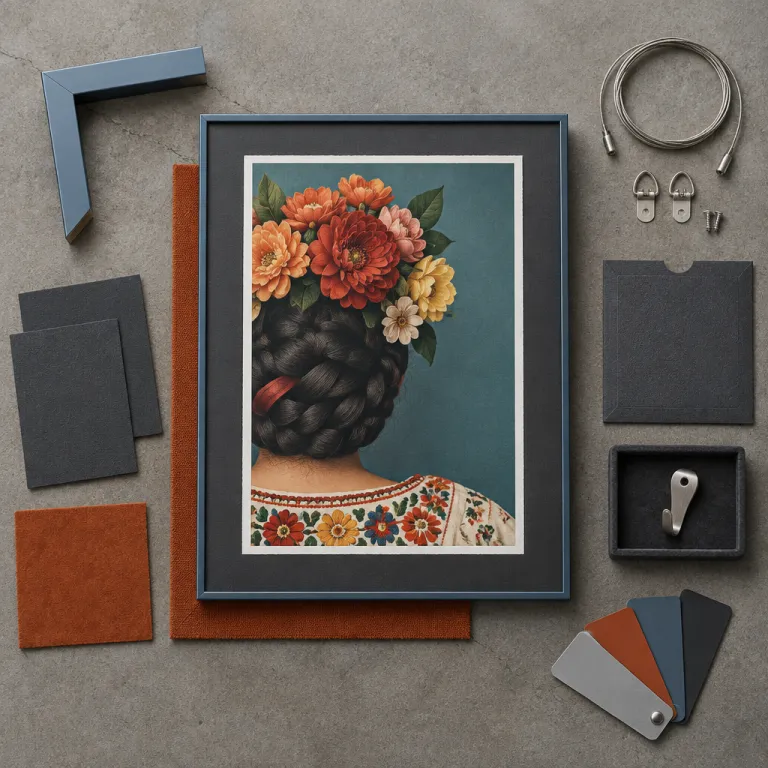
Why prints of Frida Kahlo anchor a luxury collection
For serious collectors, curated prints of Frida Kahlo bring museum-level art into private spaces. These fine art reproductions translate the intensity of each self-portrait into wall art that feels intimate yet rigorously composed, ideal for a refined portrait wall. When chosen with care, a single Frida Kahlo print can command an entire room and quietly signal connoisseurship.
Luxury buyers are drawn to how each likeness of Frida merges personal pain, political conviction, and meticulous craft into one concentrated image. In high-quality editions, the saturated colour fields, the precise line around every flower, and the dense foliage behind the artist become a study in twentieth-century visual language. Collectors who already own blue-chip artists often add a Kahlo portrait print to anchor their wall and to connect modern pieces with a more human, biographical narrative.
Because Frida Kahlo often worked at modest scales, the transition from original painting to art print can be unusually respectful to the source. A carefully produced portrait reproduction preserves the brushwork around the thorn necklace, the texture of the cropped hair, and the subtle modelling of the face without distortion. For luxury interiors, this balance between emotional intensity and controlled scale makes prints of Frida Kahlo more versatile than many oversized contemporary portraits.
The power of self portraiture in Frida Kahlo prints
Every serious collector of prints of Frida Kahlo eventually focuses on the self-portraits, because these works form the backbone of her art. In these images, Frida uses her own face as a stage where hair, jewellery, flowers, animals, and even hummingbirds become symbolic props. When translated into wall art, each thorn or pendant detail gains sculptural presence on the wall and rewards close viewing.
Consider the famous self-portrait with a thorn necklace and hummingbird, where the thorns cut into the skin while a lifeless bird hangs like a dark amulet. In a high-quality art print, this motif becomes a focal point that balances the surrounding floral foliage, the monkey at her shoulder, and the dense background of leaves. For a luxury portrait wall, pairing this image with another self-portrait dedicated to a patron, such as the work often referred to as a portrait dedicated to Dr Eloesser, creates a dialogue between private pain and public gratitude.
Collectors also gravitate toward the self-portrait with cropped hair, where Frida sits in an oversized suit after separating from Diego Rivera. In a carefully calibrated print, the cut hair scattered across the floor and the masculine tailoring of the clothes frame her as both vulnerable and defiant. For those exploring the psychological meaning of these images, a detailed reading of her self-portrait with Bonito, as analysed in this in-depth study of a key self-portrait, offers a useful lens for evaluating which works belong on a collector’s wall.
From Mexican roots to global walls: context for luxury buyers
Understanding the cultural context behind prints of Frida Kahlo helps collectors make more informed acquisitions. Frida was a Mexican artist whose work fused indigenous motifs, Catholic iconography, and European portrait traditions into a singular visual language. When a Kahlo wall features several self-portraits, it effectively stages a condensed history of Mexican art and politics in one curated space.
Her relationship with Diego Rivera shaped both her life and her art, and this dynamic still influences how collectors read each portrait. Some paintings were created during periods of intense emotional strain, while others, such as a portrait dedicated to friends or doctors, carry a quieter tone of gratitude. When a print of a work dedicated to a figure like Dr Eloesser hangs beside a more turbulent image linked to Diego Rivera, the wall art becomes a narrative about loyalty, betrayal, and resilience.
For luxury buyers who already collect contemporary artists, contextualising Frida Kahlo within a broader canon is essential. Her portraits sit comfortably beside works by modern painters whose mastery has been analysed in depth, such as in this study of a renowned painter’s technique found in an article about the mastery of Nathan Green. In such curated environments, a single Frida Kahlo art print can bridge Mexican muralism, European modernism, and current figurative painting, turning a portrait wall into a compact, intellectually rigorous exhibition.
Evaluating print quality, formats, and materials
For luxury collectors, the difference between ordinary prints of Frida Kahlo and investment-grade editions lies in quality. A museum-standard art print typically uses archival pigment inks on acid-free cotton paper, with colour calibration that respects the original paintings. When assessing art prints, examine how faithfully the floral motifs, the texture of the hair, and the subtle shadows around the necklace are rendered.
Scale matters as much as material in high-end wall art. Oversized prints can overwhelm the intimacy of a Kahlo portrait, while editions that are too small risk losing the emotional charge of the thorn necklace or the tension in the cropped hair. For a refined portrait wall, many collectors choose medium formats that allow the viewer to read every flower, every hummingbird, and every strand of hair without stepping too close.
Framing choices complete the luxury experience and should echo the vintage aura of the original works without sliding into pastiche. Slim, dark wood frames often complement the earthy palette of Mexican art, while floating frames can give a contemporary edge to a classic composition featuring animals or symbolic jewellery. Collectors who commission custom frames sometimes integrate subtle floral carving or a narrow gilt line, reinforcing the botanical and necklace motifs without distracting from the central figure in each portrait.
Curating Frida Kahlo prints in contemporary interiors
Thoughtful placement of prints of Frida Kahlo can transform a neutral interior into a deeply personal environment. In a minimalist living room, a single portrait positioned on a central wall becomes a visual anchor that balances clean lines with emotional depth. When several art prints are grouped, alternating works with strong floral backgrounds and more austere cropped-hair images creates rhythm across the wall.
Collectors often build a portrait wall that traces Frida’s evolving self-image through different phases of her career. One section might feature a composition dominated by thorns and a hummingbird, while another highlights a cropped-hair work where the act of cutting becomes a symbol of autonomy. By interspersing these with a portrait dedicated to a patron and a quieter scene that includes animals or companions, the wall art narrates a life story rather than merely displaying popular images.
Luxury interiors also benefit from dialogue between Frida Kahlo prints and works by other artists. A Mexican art corner might pair a Frida edition with drawings by Diego Rivera or contemporary Mexican painters who reinterpret floral and vintage motifs. For collectors tracking new talent, this strategy aligns with the kind of forward-looking curatorial thinking discussed in analyses of emerging artists and institutional momentum, where historical anchors like Frida Kahlo stabilise more speculative acquisitions.
Market dynamics and provenance for Frida Kahlo prints
The market for prints of Frida Kahlo has matured into a sophisticated segment where provenance and edition control are paramount. Serious collectors prioritise prints issued or authorised by reputable museums, estates, or foundations that hold the original art. Such editions usually come with detailed documentation, including information about the source painting, the print run, and the printing process used to capture every flower and every strand of hair.
Within this market, certain images command particular attention, especially those featuring iconic motifs like the thorn necklace, the hummingbird pendant, or the intense gaze framed by dense foliage. Limited-edition prints of these portraits, especially when linked to major exhibitions, tend to be more popular among buyers who value both cultural significance and potential long-term stability. Collectors often assemble small series that include a composition centred on jewellery, a work with animal companions, and a cropped-hair self-portrait, creating a micro-collection that reflects the range of Frida’s self-representation.
While original paintings by Frida Kahlo are firmly in the realm of institutional collections and top-tier auctions, high-quality prints allow private buyers to participate meaningfully in this legacy. The key is to treat each acquisition with the same rigour applied to other blue-chip artists, scrutinising print quality, edition size, and the reputation of the issuing body. In this way, a carefully curated Kahlo wall can stand beside collections of twentieth-century masters and contemporary artists without feeling secondary or derivative.
Key figures and market statistics for Frida Kahlo prints
- Public auction records from major houses such as Christie’s and Sotheby’s show that original paintings by Frida Kahlo have reached prices in the tens of millions of US dollars, which indirectly boosts demand and perceived value for high-quality prints of Frida Kahlo among collectors priced out of the primary painting market.
- Major museum exhibitions dedicated to Frida Kahlo, including shows at institutions such as Tate Modern and the Brooklyn Museum, have attracted visitor numbers in the hundreds of thousands, demonstrating sustained global interest that supports a robust market for both single-print editions and curated portfolios of art prints.
- Industry surveys of luxury interior designers in Europe, reported in trade publications over the past decade, indicate that client requests for figurative wall art featuring strong female portraits have risen significantly, reinforcing the relevance of portrait-focused wall installations that include Frida Kahlo imagery.
- Manufacturers of archival pigment prints on cotton rag paper often cite laboratory tests suggesting a rated longevity of several decades under museum conditions, meaning that a well-produced Frida Kahlo edition can retain colour fidelity for the lifetime of a collector when displayed away from direct sunlight.
- In the wider print market, limited editions with print runs below roughly 150 copies typically command a noticeable price premium over open-edition wall art, a pattern that also applies to carefully controlled Kahlo portrait editions issued by major institutions.
FAQ: prints of Frida Kahlo for luxury collectors
Which Frida Kahlo portraits translate best into luxury prints ?
Portraits that feature strong central compositions, such as those with a thorn necklace, a hummingbird pendant, or a clearly framed figure against dense foliage, tend to reproduce exceptionally well as art prints. These images maintain visual impact at various scales and integrate easily into a sophisticated portrait wall.
How can I verify the quality and authenticity of a Frida Kahlo print ?
Look for documentation that specifies archival pigment printing, acid-free paper, and a clearly stated edition size, ideally issued or endorsed by a recognised museum or foundation. Authentic prints of Frida Kahlo should include detailed information about the source artwork and the production process, not just a generic certificate.
What framing approach suits Frida Kahlo wall art in a modern interior ?
Many collectors choose slim, dark wood or black frames that echo the vintage character of the portraits while remaining discreet. Floating frames or minimal mounts allow the floral backgrounds, the hair details, and the central jewellery motifs to remain the focus of the wall art.
Are Frida Kahlo prints a good long term addition to a blue chip collection ?
While prints do not occupy the same market tier as original paintings, high-quality, well-documented editions of key portraits can be a stable and culturally significant component of a blue-chip collection. They offer access to an essential twentieth-century artist while preserving capital for other acquisitions.
How many Frida Kahlo prints should I include on one wall ?
For a luxury setting, three to five carefully chosen prints usually create a balanced portrait wall without visual overload. Mixing one intense composition with thorns and symbolic animals with quieter dedicated portraits often yields the most harmonious result.
