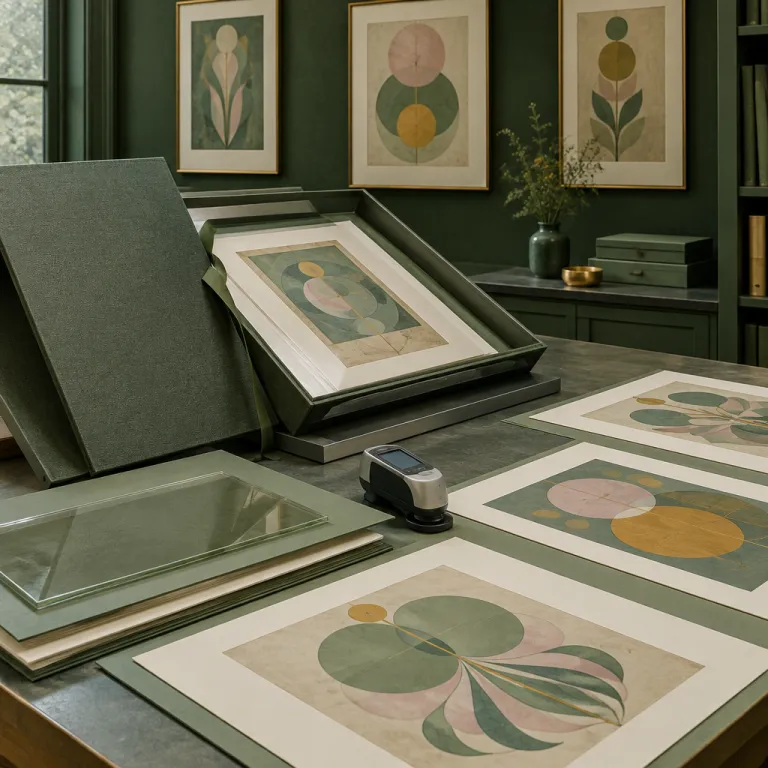
Hilma af Klint prints as a new pinnacle of spiritual luxury
For the serious collector, Hilma af Klint prints now represent a discreet yet powerful form of spiritual luxury. These works by the Swedish artist Hilma af Klint predate much canonical abstract art and bring a rare sense of historical depth into any high end interior. When you acquire a single art print or several coordinated reproductions, you are effectively buying access to a private language of symbols, colours, and esoteric geometry.
Hilma af Klint worked in a close circle of women artists, and this group produced paintings that feel astonishingly contemporary in a luxury context. The most coveted Hilma af Klint prints today often reproduce the series known as The Ten Largest, whose monumental originals reach more than 3 m in height and translate beautifully into large format prints for expansive walls. When you select a print from The Ten Largest series, you are not just choosing abstract art but curating a visual biography of earthly life from childhood to old age.
Collectors appreciate that each Hilma af Klint print carries a clear position on the relationship between earthly life and the spiritual realm. This perspective runs through her cycles of flowers, spirals, and diagrams that feel at once scientific and mystical. In the luxury segment, buyers increasingly seek fine art that offers both aesthetic pleasure and intellectual content, and Hilma af Klint prints answer that desire with unusual authority, especially since major retrospectives such as the 2013 Moderna Museet survey in Stockholm and the 2018–2019 Guggenheim exhibition in New York brought her work decisively into the global canon.
The ten largest, swan and altarpiece series as museum grade statements
Among all Hilma af Klint prints, three collections dominate the attention of connoisseurs who want museum grade statements at home. The Ten Largest series, with its vast ovals and biomorphic forms, becomes especially compelling when translated into large canvas prints that echo the scale of the originals. A carefully chosen framed art print from this cycle can anchor a salon wall in the same way a major canvas by a blue chip modernist might do.
The Swan series offers another facet of Hilma af Klint, where duality, union, and transformation unfold through black and white birds, radiant circles, and coded letters. Luxury buyers often pair a Swan art print with a work from the Altarpiece series to create a dialogue between earthly life and a more elevated spiritual position within the same room. When these prints are framed with museum grade glazing and minimalist profiles, they rival the quiet intensity of Gustav Klimt posters presented as refined wall art for the luxury collector, yet they remain more conceptually radical.
The Altarpiece paintings, originally conceived as focal points for a spiritual temple, translate into Hilma af Klint prints that feel almost architectural in a contemporary penthouse. Their triangular compositions and golden discs resonate strongly with collectors who appreciate abstract art that still hints at sacred architecture. In a carefully curated group of prints, a single Altarpiece reproduction can function as the visual keystone that holds the entire collection together, particularly when it is printed in a format that respects the original proportions and colour balance.
From studio to salon: how a Swedish artist reshaped abstract art for collectors
Hilma af Klint worked quietly as a Swedish artist in Stockholm, developing a private visual system long before abstract art became a public movement. Her studio practice combined séances, automatic drawing, and disciplined geometric planning, which now gives Hilma af Klint prints an unusually rich backstory for luxury buyers. When you hang one of these art prints in a residence, you are importing not only colour and form but also a century of delayed recognition and critical reassessment.
For collectors who track emerging and rediscovered artists, Hilma af Klint offers a textbook case of how market narratives evolve. Her work remained largely unseen for decades, then major museums presented landmark exhibitions that repositioned her as a pioneer of fine art abstraction, which in turn elevated the desirability of Hilma af Klint prints. If you are interested in understanding how such shifts create opportunity, a detailed framework such as a breakout thesis on how to spot an emerging artist before the galleries do can sharpen your position on timing and value.
Luxury buyers who already collect Russian avant garde works or who study the opulence of Russian artistry often find a natural bridge toward Hilma af Klint. Both contexts share a fascination with spiritual symbolism, coded geometry, and the tension between earthly life and transcendence, which makes mixed collections visually coherent. When you integrate Hilma af Klint prints into a broader hanging that might also include works inspired by exploring the opulence of Russian artistry, you create a cross cultural narrative that feels both scholarly and sensuous, especially when each piece is documented with clear provenance and edition details.
Pricing, editions and the luxury logic of Hilma af Klint prints
In the luxury segment, the question of price is never purely numerical; it reflects scarcity, narrative, and curatorial quality. Hilma af Klint prints are typically offered in carefully controlled editions, with a clear distinction between regular price points for open editions and higher sale price levels for limited runs or special formats. Collectors who understand this structure can evaluate whether a given price sale truly reflects rarity or simply a marketing gesture.
When a gallery or content shop presents Hilma af Klint prints, you will often see both regular price and temporary price sale indications, especially around a major exhibition. A thoughtful buyer compares the sale price not only to the previous regular price but also to the broader market for comparable fine art prints by other pioneering artists. In many cases, the most compelling value lies in large format canvas prints or meticulously framed editions that are ready to hang, because the incremental cost of framing is outweighed by the immediate impact in a luxury interior.
Some platforms segment their offerings into a Hilma af Klint group of curated works, where each print is vetted for colour fidelity and paper quality. Within such a group, The Ten Largest series often commands the highest price because of its iconic status and the technical demands of reproducing such complex surfaces. For serious collectors, the key is to treat Hilma af Klint prints as long term cultural assets rather than decorative purchases, aligning acquisition strategy with the same rigor applied to blue chip paintings and tracking edition sizes, certificates of authenticity, and any collaboration with the Hilma af Klint Foundation or museum publishers.
Curating themes: flowers, earthly life and the buddha standpoint
One of the pleasures of collecting Hilma af Klint prints lies in building thematic constellations rather than isolated pieces. Many collectors begin with works featuring stylised flowers, then gradually expand toward more diagrammatic compositions that map earthly life as a sequence of spiritual stages. This progression mirrors Hilma af Klint’s own journey, moving from botanical studies to visionary abstractions that weave together Christian, Theosophical, and Eastern influences into a single symbolic language.
Within her oeuvre, you can trace a contemplative standpoint that synthesises these traditions into concentric circles, intersecting triangles, and radiant colour fields that read beautifully in a minimalist luxury interior. When you juxtapose such a print with more figurative flowers or Swan motifs, you create a layered narrative about transformation, duality, and the passage from matter to spirit.
Collectors who enjoy intellectual depth often assemble small groups of Hilma af Klint prints that each represent a different standpoint on earthly life. One framed art print might focus on childhood from The Ten Largest series, another on the union of opposites from the Swan cycle, and a third on transcendence from the Altarpiece paintings. This kind of curated group transforms a corridor or private study into a contemplative gallery that rewards repeated viewing, particularly when each work is accompanied by concise wall texts or captions that explain its place within the original series.
Presentation, framing and the role of contemporary studios
The way Hilma af Klint prints are presented can elevate them from interesting reproductions to true luxury objects. High end collectors typically favour archival paper or finely textured canvas, combined with discreet frames that echo the geometry of the compositions without competing for attention. A well chosen framed print, properly lit and positioned, can hold its own beside original paintings in a sophisticated collection.
Specialised studios and contemporary ateliers have refined production techniques that respect the chromatic subtleties of Hilma af Klint’s abstract art. These workshops often collaborate with estates, museums, or authorised publishers to ensure that each art print or series of art prints meets strict standards of colour accuracy and material longevity. When a print is described as ready to hang, discerning buyers still verify the quality of the frame, the backing, and the glazing, because these details determine how the work will age in a high value environment.
Digital platforms sometimes include navigation prompts such as skip to content or skip content, but serious collectors quickly move beyond interface details to assess the underlying quality of the prints. They look for clear information about edition size, printing method, and whether the work forms part of larger collections that mirror the original sequencing conceived by Hilma af Klint. In this context, the role of contemporary studios is not merely technical; it is curatorial, translating the vision of a pioneering Swedish artist into tangible fine art objects for a new generation of luxury buyers, and many now add image alt text, provenance notes, and short expert comments from curators or print specialists to support informed decisions.
Key statistics on Hilma af Klint and the market for her prints
- Major museum exhibitions of Hilma af Klint have attracted substantial visitor numbers, signalling intense public interest that supports demand for Hilma af Klint prints; for example, the Guggenheim’s 2018–2019 show reportedly drew more than 600,000 visitors and became one of the museum’s most attended exhibitions.
- Since the global surge of attention to Hilma af Klint, auction records for works by early abstract artists have risen over several market cycles, which indirectly strengthens the perceived value of high quality art prints, especially when they are produced in limited editions with documented provenance.
- Large format fine art prints, including canvas editions inspired by series such as The Ten Largest, often command notable premiums over smaller formats, reflecting both production costs and the desire for statement pieces in luxury interiors.
- Surveys of high net worth collectors by major art market reports indicate that many now consider spiritual or conceptual depth a key factor in acquisition decisions, a trend that aligns closely with the appeal of Hilma af Klint’s spiritually charged abstract art and the growing interest in museum grade reproductions.
FAQ about Hilma af Klint prints for luxury collectors
Are Hilma af Klint prints considered investment grade for serious collectors?
Hilma af Klint prints are not originals, but they benefit from the artist’s rapidly rising institutional profile and the scarcity of her works on the primary market. For collectors, they function as culturally significant, relatively accessible entries into a historically important oeuvre. Investment potential depends on edition size, production quality, and alignment with key series such as The Ten Largest, Swan, or Altarpiece cycles, as well as whether the print is issued or endorsed by recognised museum publishers or the artist’s foundation.
Which Hilma af Klint series translate best into large format luxury prints?
The Ten Largest series is particularly suited to large format because the originals were conceived on a monumental scale and rely on expansive colour fields. The Swan and Altarpiece series also translate well, especially when printed on canvas with meticulous colour management. Collectors often choose these cycles for grand spaces such as double height living rooms or gallery style corridors, where the compositions can be viewed from multiple distances.
How should I frame Hilma af Klint prints for a high end interior?
For a luxury setting, use archival materials, UV protective glazing, and frames that echo the geometry of the composition without overwhelming it. Slim, well crafted profiles in natural wood, matte black, or soft metallic finishes tend to complement her abstract forms. Always ensure professional mounting to avoid warping or discolouration over time, and consider non reflective glazing in rooms with strong natural light.
What is the difference between paper and canvas editions of Hilma af Klint prints?
Paper editions usually offer sharper detail and a closer relationship to traditional printmaking, while canvas editions emphasise scale and a more painterly presence on the wall. Canvas can be particularly effective for works from The Ten Largest or Altarpiece series, where size and surface play a major role. The choice depends on whether you prioritise intimacy and precision or impact and spatial presence, and on how the print will sit alongside existing artworks in your collection.
How can I verify the quality and authenticity of Hilma af Klint prints?
Look for clear documentation about the publisher, edition size, printing method, and any collaboration with the artist’s foundation or major museums. Reputable galleries and specialised studios provide certificates of authenticity and detailed specifications about paper or canvas, inks, and framing options. When in doubt, compare offerings across several established dealers to ensure that both price and quality align with market standards, and review any expert notes or curatorial texts that accompany the edition.