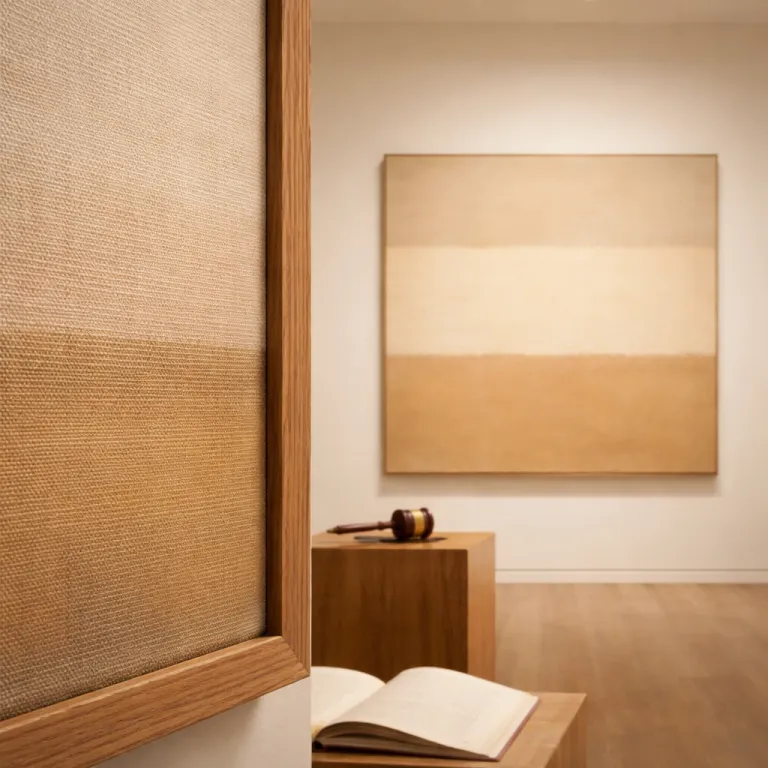
Rothko, Mnuchin and why dealer estates trade above the field
The Sotheby’s May 2026 Rothko auction in New York hinged on one painting. Mark Rothko’s Brown and Blacks in Reds, from the personal collection of art dealer Robert Mnuchin, realized a reported 85.8 million dollars against a 70 to 100 million dollar estimate, anchoring an evening sale widely cited at roughly 389.3 million dollars that appeared to rebalance the contemporary art market toward canonical postwar works. For any collector watching New York sales as a barometer, that single lot suggested that blue-chip art with impeccable provenance still commands a structural premium, a point underscored by early coverage on Artnet and ARTnews and by the Sotheby’s lot page for the Mnuchin estate consignment.
Provenance was the real engine here, because Robert Mnuchin was not just another consignor but the dealer who helped shape the market for Mark Rothko and his peers. When a Robert Mnuchin collection work appears at auction, buyers are paying for decades of connoisseurship, private vetting and museum-level access, and that is why this sale drew institutional bidding that anonymous sellers rarely achieve in contemporary evening sessions. In this case the art market read the signal clearly, treating the painting less as one more New York lot and more as a reference price for future sales of comparable works by Rothko, Willem de Kooning and Franz Kline, much as the 2012 Christie’s sale of Rothko’s Orange, Red, Yellow at 86.9 million dollars became a benchmark for later Color Field transactions.
Look closely at the painting’s structure and you see why the market leaned in. The stacked fields of browns, blacks and dark reds over a charged red ground sit squarely in the period that major museums and top collectors prize, and they echo related works in the National Gallery of Art and the Museum of Modern Art without feeling like studio variants. For a sophisticated collector, that combination of visual intensity, secure period, exhibition comparables and direct link to a legendary art dealer explains why this particular Rothko color field composition, though titled, behaved like a trophy among trophies at the Sotheby’s evening auction, reinforcing the pattern seen when a major Franz Kline abstraction brought more than 40 million dollars in a recent New York sale.
How Mnuchin’s eye, timing and relationships shaped the May result
The architecture of the Sotheby’s May 2026 Rothko auction was pure Mnuchin, even though it was his estate on the block. Robert Mnuchin spent decades arbitraging taste between museums, private collectors and the big houses like Christie’s and Sotheby’s, and his choices around Mark Rothko, Willem de Kooning and Franz Kline effectively curated the New York sales calendar long before this evening sale. When his own collection surfaced, the market treated it as a syllabus of postwar contemporary art rather than a routine liquidation, and the Mnuchin estate catalogue read like a condensed history of mid-century abstraction for anyone tracking Rothko auction results.
Timing mattered as much as provenance, because the broader art market had cooled on ultra-contemporary names while quietly rotating back to mid-century works. Against that backdrop, a Robert Mnuchin collection Rothko with such strong color and scale looked less like a risk asset and more like a benchmark, and the aggressive third-party backing on the lot confirmed that reading for every collector in the room. For buyers who had watched Christie’s and other houses test similar material with mixed results, this New York auction felt like the moment when institutional demand finally caught up with long-term curatorial consensus, and early season tallies suggesting a roughly 2.5 billion dollar spring across the major houses gave the Sotheby’s May 2026 evening sale additional weight.
The rest of the catalogue reinforced that narrative with carefully chosen works by Willem de Kooning, including a major de Kooning Untitled canvas, and by peers such as Roy Lichtenstein and Andy Warhol. Even when individual works like an Untitled III or a smaller de Kooning untitled study did not set records, they cleared comfortably within estimate ranges, suggesting that the market now differentiates sharply between vetted postwar works and speculative contemporary evening consignments. For collectors tracking the whole spring week, cross-reading this sale with Phillips’ New York contemporary evening catalogue choices, as analysed in this spring week auction outlook and in a separate guide to how auction houses structure evening sales, gives a clearer sense of how supply, not hype, is steering pricing.
What the Rothko price means for your postwar holdings
For a seasoned collector holding postwar Color Field works, the Sotheby’s May 2026 Rothko auction is less a spectacle than a pricing tool. The 85.8 million dollar result for Brown and Blacks in Reds effectively resets expectations for comparable Mark Rothko paintings, but it also lifts adjacent segments, from strong Franz Kline abstractions to muscular Willem de Kooning canvases and even historically resonant Roy Lichtenstein and Andy Warhol works. In practical terms, it tells you that secure period, clear exhibition history and a coherent collection context now matter more than ever when you consider a sale or a reinvestment, and that verified data from Sotheby’s press releases or Artnet sale reports should anchor any discussion of value.
If you are sitting on a major Rothko untitled canvas, a de Kooning untitled abstraction or a significant work nicknamed something like Broadway Meltdown in your own records, this is the moment to reassess insurance, lending and potential auction strategy. A detailed valuation that weighs estimate bands, recent New York sales and the specific role of your work within the broader art market is essential, and resources that unpack how auction houses actually build estimates, such as this guide to the five factors behind painting valuations, can sharpen that conversation with your advisor. The key is to treat the Mnuchin sale not as a one-off spike but as a data point within a 2.5 billion dollar season that may mark a structural shift back toward mid-century material, a shift that will show up not only in headline Rothko auction prices but also in the quieter private treaty deals that follow.
Strategically, you now face a choice between consigning into this renewed demand or using the higher marks to refinance and quietly buy into under-loved corners of contemporary art. That might mean trading a secondary-tier work linked to a glamour subject such as Brigitte Bardot for a more rigorous abstraction, or swapping a minor Broadway-themed canvas for a museum-level piece with stronger provenance and less flashy narrative. For help mapping whether an art advisor, a gallery relationship or a direct auction consignment best serves that plan, the framework laid out in this analysis of the roles of advisors, galleries and auction houses is a useful starting point, because in this segment the real luxury is not the certificate but the wall it earns.