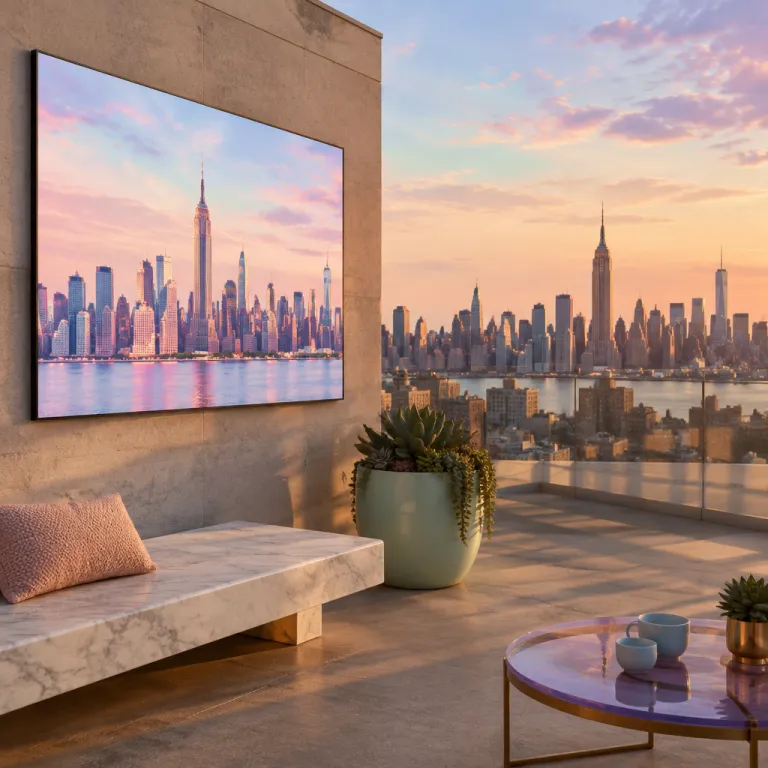
From souvenir to statement: when a New York New York poster enters the luxury sphere
A refined New York New York poster stops being a simple travel memory when it treats the city as a collectible subject. In the luxury segment, the same New York skyline that fills tourist shops in NYC is reimagined through museum-grade materials, archival pigment inks, and meticulous digital art direction that can stand beside blue-chip works. Serious collectors look for a poster that can capture Manhattan with the gravitas usually reserved for painting or sculpture, echoing how institutions like MoMA and the Whitney have elevated photography and prints into core holdings.
At this level, the word “poster” becomes almost misleading, because each print is handled like a limited-edition artwork. A luxury New York New York poster is usually printed on heavyweight cotton rag paper, with a carefully profiled print workflow that preserves every nuance of the skyline and every reflection in the Lower Manhattan waters. The result is a piece that feels as considered as a gallery photograph of New York City, not a mass-market travel souvenir from Midtown gift shops, and aligns with conservation research showing that archival pigment prints on rag paper can maintain visual integrity for several decades under controlled lighting.
Curators now treat the New York New York poster category as an accessible gateway into serious city collecting. They examine how the design frames the state landmarks, how the composition balances the famous skyscrapers with the human scale of the streets, and how the work will age in dialogue with the history of New York Times architecture coverage. When those criteria are met, a single poster or a wall of carefully sequenced NYC skyline prints can elevate an entire room, much as tightly curated photography walls do in contemporary design-led apartments.
Digital artistry and the black and white skyline: luxury minimalism for NYC collectors
Digital techniques have transformed the classic black and white New York New York poster into a sophisticated object of desire. High-resolution city photography is now blended with 3D modeling, generative textures, and subtle grain overlays to create a skyline that feels both cinematic and tactile. For the luxury buyer, the question is no longer whether the work is printed digitally, but how intelligently that digital art process has been used to capture Manhattan, a shift mirrored in auction catalogues where “pigment print” and “digital composite” now sit comfortably beside gelatin silver prints.
In monochrome, every tonal decision matters, especially when the subject is New York City at night with thousands of LED windows glowing. Collectors scrutinize how the artist handles the deep blacks of Lower Manhattan, the midtone haze over the East River, and the delicate whites around the Empire State Building spires, because these choices will determine whether the poster reads as timeless or merely trendy. A well-executed black and white print can echo the visual rigor of fine art photography while still honoring the graphic immediacy of a poster, a balance that has helped monochrome Manhattan prints remain among the most requested formats for design-conscious living rooms.
For those exploring tonal nuance, expert guidance on how refined color filters sculpt black and white photography for the luxury art collector offers a useful framework for judging a New York New York poster. The same principles apply when evaluating a series of posters that reinterpret the New York skyline from dawn to night, each printed with slightly different contrast curves. When these digital decisions are made with restraint, the final design feels calm, architectural, and perfectly suited to a pared-back NYC penthouse interior, where minimalism and quiet detail tend to outlast short-lived decor trends.
LED nights and digital glow: simulating light in luxury New York New York posters
Nighttime views of the city have become the signature motif for many high-end New York New York poster editions. Artists now simulate the precise behavior of LED signage in Times Square, the warm halogen glow of older New York City apartments, and the cool reflections on the Hudson using layered digital painting techniques. This fusion of photography and illustration allows them to capture Manhattan energy without overwhelming a luxury interior with visual noise, a concern frequently cited in surveys of urban collectors who favor atmospheric city imagery over literal postcard views.
Advanced digital artistry treats each window in the skyline as a micro composition, adjusting opacity, hue, and bloom to suggest depth behind the glass. When the final artwork is printed on a matte fine art paper, the contrast between the soft surface and the illusion of electric light creates a subtle tension that collectors find compelling, especially in large-format print sizes above 80 cm. Some ateliers, such as boutique studios in Brooklyn and Tribeca, even offer paired posters that show Lower Manhattan in full LED brilliance beside a more restrained black and white version, inviting a dialogue between spectacle and serenity and echoing the way museum exhibitions often juxtapose day and night city views.
For technologically inclined buyers, discussions of automated photography and refined automation for luxury digital artwork explain how algorithmic tools can assist without replacing the artist’s eye. The most respected studios use automation only to pre-sort exposures or align skyline elements, then rely on hand retouching to honor the history of iconic New York Times images of NYC. In this way, each New York New York poster will retain a distinct signature, even when the city subject and the famous state landmarks remain constant, and the collector can trace a recognizable authorial style across multiple Manhattan prints.
Composing the skyline: design strategies that separate luxury posters from mass prints
Composition is where a New York New York poster either joins the luxury conversation or stays in the realm of generic travel art. Serious collectors look first at how the skyline is framed, whether the artist chooses a sweeping New York City panorama or a tightly cropped view of Lower Manhattan that emphasizes structural rhythm. The most successful posters use negative space, horizon placement, and architectural alignment to guide the eye with the same care seen in museum photography, often sketching multiple thumbnail layouts before committing to a final NYC skyline poster design.
One enduring strategy is to place a single famous state building slightly off center, allowing the surrounding city grid to counterbalance its weight. This approach works beautifully in both color and black and white, especially when the print is large enough that individual windows and street patterns become almost abstract. Another sophisticated tactic is to echo the vertical thrust of Manhattan towers with the proportions of the poster itself, choosing a tall, narrow design that will visually elongate a wall in a NYC apartment and subtly reference the soaring feel of standing at street level among skyscrapers.
Collectors who already own painting or watercolor pieces often pair them with a digitally crafted New York New York poster to create a layered narrative about the city. A detailed guide on how to read a contemporary watercolor for craft and value can help frame this dialogue between mediums, especially when the watercolor captures June light over the skyline and the poster focuses on nocturnal LED reflections. When curated thoughtfully, the mix of posters, prints, and paintings will tell a richer story about New York, its history, and its evolving design language, turning a simple wall into a compact visual archive of the city.
From campus walls to penthouse galleries: how context reshapes the New York New York poster
The same New York New York poster can read very differently in a student room and in a private gallery. On campuses, especially in art departments at major colleges and universities in New York City, posters often serve as aspirational windows toward a future life in NYC. In that context, a printed skyline above a desk is more about travel dreams and New York Times internship ambitions than about archival quality or state-of-the-art inks, and the emphasis falls on mood and motivation rather than on edition size or provenance.
In a penthouse or townhouse, the expectations change completely, because the poster must hold its own among paintings, sculptures, and rare photography. Collectors assess whether the print has been produced on acid-free paper, whether the blacks in a black and white skyline remain stable under controlled lighting, and whether the design will still feel relevant when the city inevitably evolves. Many commission custom sizes so that a single view of Lower Manhattan can anchor an entire wall, turning a once casual poster into the focal point of a room and aligning it with the way interior designers specify statement works on paper for key sightlines.
Interestingly, some of the most sophisticated New York City collections now include curated clusters of posters sourced from both galleries and historic colleges and universities archives. A vintage campus poster of Manhattan, a contemporary digital print of Times Square, and a limited-edition black and white view of the skyline can together trace the history of how artists capture New York over decades. When framed uniformly, these varied posters will form a coherent narrative that bridges youth, travel, and mature collecting, and they often become conversation pieces that reveal the owner’s personal connection to the city.
Collecting strategy: evaluating value, rarity, and long term resonance
Approaching a New York New York poster as a serious acquisition requires the same discipline you would apply to photography or works on paper. Start by examining the edition size, the reputation of the studio that printed the work, and the clarity of the artist’s vision for the city subject. A small, well-documented edition that captures Manhattan with a distinctive digital language will generally hold value better than an open-edition print, even if both depict the same famous skyline, a pattern echoed in market reports that track stronger resale performance for tightly controlled series.
Rarity is not only about numbers; it is also about perspective and timing. A poster that focuses on Lower Manhattan before a major change in the skyline, or that records a specific June light condition over New York City, can become historically resonant as the urban fabric evolves. Collectors who follow New York Times architecture and culture coverage often anticipate which city views will feel iconic in retrospect, then seek posters and prints that embody those moments, much as photography buyers pursue early images of now-transformed neighborhoods.
Finally, consider how the work will live with you over years, not seasons. Ask whether the design still feels compelling when viewed in both daylight and LED evening lighting, and whether the black and white or color treatment aligns with your broader art holdings. When a New York New York poster continues to reward close looking, revealing new details in the print and new layers of history in the skyline, it has earned its place in a luxury collection and can stand alongside paintings, photographs, and limited-edition Manhattan prints as a long-term anchor of your interior.
Key figures shaping the market for luxury New York New York posters
- Industry surveys on the global art market consistently show that works on paper and prints represent a significant share of fine art transactions by value, underscoring that high-quality printed art, including city posters, is now a core collecting category rather than a peripheral niche, and that serious buyers increasingly treat a New York New York poster as a legitimate asset.
- Recent data from New York City tourism authorities indicates that the city welcomes tens of millions of visitors in strong travel years, and this sustained interest helps maintain robust demand for skyline-themed art and posters depicting New York City landmarks, from Midtown icons to more intimate Lower Manhattan views.
- Market analyses from major auction houses suggest that limited-edition photographic prints of Manhattan and Lower Manhattan have seen steady price growth over the past decade, pointing to a healthy appetite for well-executed city imagery and reinforcing the case for carefully produced NYC skyline posters as part of a diversified collection.
- Conservation research from leading museums notes that archival pigment prints on cotton rag paper can maintain color stability for several decades under controlled lighting, which supports the long-term viability of luxury New York New York poster editions and justifies the premium charged by studios that follow strict printmaking standards.
- Surveys of design-conscious buyers in large metropolitan areas indicate that black and white artwork remains one of the top preferred aesthetics for living room walls, reinforcing the enduring appeal of monochrome skyline posters in luxury interiors and explaining why many Manhattan prints are released in both color and black and white variants.
FAQ about luxury New York New York posters and digital skyline art
How do I know if a New York New York poster is archival quality?
Look for clear information about the paper type, such as 100% cotton rag, and about the inks, ideally pigment-based rather than dye-based. Reputable studios will specify that the work is printed with archival materials and may reference independent longevity tests. If those details are missing, treat the poster as decorative rather than collectible, and assume it will behave more like a temporary print than a long-term Manhattan art investment.
Is a black and white skyline poster less valuable than a color version?
Value depends on artistic quality and scarcity, not on whether the work is black and white or color. Many collectors prize monochrome views of Manhattan because they emphasize structure, light, and history without distraction. Some of the most sought-after New York City prints at auction are black and white photographs and posters, and a strong monochrome New York New York poster can feel even more timeless than a saturated color edition.
What size should I choose for a luxury New York New York poster?
For a primary focal point above a sofa or console, formats between 70 and 100 cm on the long side usually feel substantial without overwhelming a room. In corridors or above desks, smaller prints around 40 to 60 cm can work well, especially when grouped as a series. Always measure the wall and leave generous negative space so the skyline can breathe, and consider how the proportions of the NYC skyline poster echo the architecture of your space.
Are digitally created skyline posters considered fine art?
Digital origin no longer disqualifies a work from serious consideration; what matters is authorship, craft, and conceptual clarity. When an artist uses digital tools to thoughtfully capture New York City, controls the print process, and limits the edition, the resulting poster can sit comfortably alongside photography and traditional prints. Many museums now collect digitally produced works on paper as part of their contemporary art holdings, and the same logic applies to a carefully authored New York New York poster.
How should I frame and light a New York New York poster in a luxury interior?
Use museum-grade, UV-filtering glazing and acid-free mounting materials to protect the print over time. Simple frames in black, white, or natural wood tend to complement both color and black and white skylines without competing with the city imagery. For lighting, aim for even, indirect illumination and avoid placing the poster where strong LED or daylight will strike it directly, so that the tonal subtleties of the Manhattan skyline remain intact for as long as possible.