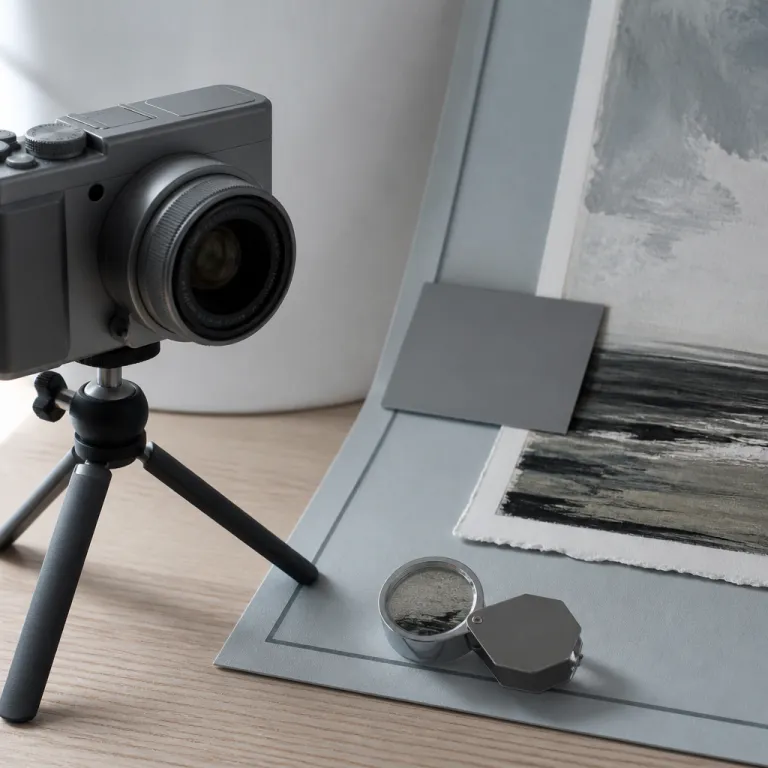
Coolpix A camera as a precision tool for luxury digital artworks
The Nikon Coolpix A camera occupies a rare niche where compact discretion meets gallery-grade precision. In the hands of a luxury artwork lover, this APS-C compact becomes a portable studio that respects both the artwork and the collector’s time. Its understated magnesium-alloy body and tactile dials appeal to connoisseurs who expect a camera to feel as refined as the pieces it records.
At the heart of the Coolpix A lies a 16.2-megapixel DX-format CMOS sensor (approximately 23.6 × 15.6 mm) without an optical low-pass filter, a configuration that rivals many larger interchangeable-lens cameras for detail rendition. This sensor, paired with a fixed 18.5 mm f/2.8 NIKKOR lens (roughly a 28 mm equivalent field of view), preserves subtle tonal transitions and delicate brushwork in paintings, sculptures, or installations. According to Nikon’s official specifications, this combination delivers high resolving power across the frame, which supports serious cataloguing, insurance documentation, and digital exhibition printing. Luxury collectors who commission digital editions quickly understand that a large-sensor compact body is not a gadget but an essential part of their curatorial toolkit.
For high-value works, control over exposure and focus is non-negotiable, and the Coolpix A responds with a precise command dial and direct access to exposure compensation. The main mode dial lets you move from aperture priority to full manual without breaking concentration on the artwork itself. In practice, a collector might work in aperture priority for framed pieces in a gallery, using moderate ISO values and small apertures to protect highlights and maintain depth of field. This Nikon compact therefore behaves like a miniature studio rig, yet it remains small enough to slip beside a catalogue in a briefcase when you travel between galleries.
Rendering texture and pigment with a large sensor and refined optics
Luxury artwork often lives or dies by the way texture is rendered, and the DX-format sensor inside the Nikon Coolpix A is central to that challenge. When you photograph a heavily impasto canvas or a lacquered sculpture, the sensor and 18.5 mm f/2.8 lens must hold micro-contrast so that every ridge and reflection reads as intentional. A smaller-sensor compact tends to flatten these nuances, while the Coolpix A preserves them with authority, especially when you stop down to f/5.6–f/8 for maximum sharpness.
The fixed lens on the Coolpix A is calibrated to deliver high image quality even when used wide open at f/2.8, which is crucial in low-light salons or private viewing rooms. Collectors often prefer to avoid harsh lighting on fragile works, so a lens that performs well at higher ISO settings becomes a quiet guardian of both conservation and image fidelity. In practice, this means you can work at elevated ISO values in subdued light, rely on the camera’s noise reduction pipeline, and still obtain files suitable for large fine art prints or detailed online viewing rooms, provided you expose carefully and avoid extreme cropping.
Precise focus is equally important when recording surface detail, and the balance between autofocus and manual focus on this Nikon compact is well judged. Contrast-detect autofocus locks reliably on frame edges or sculptural contours, while manual focus with magnified live view lets you refine the plane of focus on a single brushstroke or craquelure pattern. A simple working approach is to switch to manual focus, enable focus magnification, and shoot at f/8 on a tripod for flat works. When you later compare these images to high-quality archival reproductions of iconic luxury artworks, you see how a good camera becomes part of the scholarship around texture and line.
Mastering light, shadow, and mood in digital luxury collections
Light in a collector’s residence rarely behaves like light in a museum, and the Coolpix A excels at translating these intimate atmospheres into faithful digital files. Many luxury interiors rely on subdued illumination, layered with warm accent lamps and filtered daylight that can easily confuse lesser cameras. The Nikon DX sensor, paired with thoughtful exposure controls and a base ISO of 100, allows you to respect this mood while still preserving the artwork’s true colours and tonal range.
When working in such conditions, the ability to push to higher ISO values without destroying image quality is critical, and this is where the camera’s noise reduction options become a strategic asset. You can raise ISO to maintain a safe shutter speed, then fine-tune exposure compensation with the command dial to protect highlights on varnished surfaces or metallic leaf. A typical setting for a dim room might be a mid-range ISO, a moderate aperture, and a shutter speed around 1/60 s in aperture priority, with slight negative exposure compensation to avoid clipping specular reflections. The result is a series of images that feel atmospheric yet remain technically clean enough for serious digital archiving or for creating elevated monochrome studies, which resonate with collectors of large black and white wall art.
For digital artists who build new works from photographed originals, consistent exposure and focus across a series are essential, and the Coolpix A’s mode structure supports this discipline. You can lock in aperture priority at f/8, set a base ISO, enable auto ISO with a minimum shutter speed of 1/60 s, and rely on repeatable autofocus behaviour from one session to the next. This predictability gives luxury artwork lovers the confidence that each new capture will integrate seamlessly into their evolving digital compositions and curated online galleries.
From documentation to digital artistry: macro, focal length, and creative control
Luxury collectors increasingly commission digital reinterpretations of their pieces, and the Coolpix A becomes a bridge between documentation and digital artistry. Its close-focus capability in macro mode allows you to move in on jewellery, watch dials, or intricate sculpture bases, revealing details that even careful viewers might miss. A practical macro workflow might involve setting the lens to its closest focusing distance, choosing f/5.6 for a balance of depth of field and sharpness, and using a moderate ISO with a shutter speed around 1/80 s while bracing the camera or using a small tabletop support.
The fixed 18.5 mm focal length may seem limiting at first, yet its carefully chosen wide-angle field of view encourages a disciplined approach that many digital artists appreciate. Rather than zooming casually, you move your body around the artwork, exploring perspective shifts that reveal new compositional possibilities. This physical engagement with the piece often leads to more thoughtful framing, especially when you combine manual focus with the command dial to place emphasis on a single signature, crackle pattern, or gemstone facet. For flat works, standing slightly further back and keeping the sensor plane parallel to the artwork helps minimize distortion and keeps lines straight.
For those who also shoot video sketches as part of their creative process, the Coolpix A’s video mode offers a practical way to capture moving impressions of an installation or performance piece. It records Full HD footage at standard frame rates and handles exposure and focus transitions smoothly enough for reference clips and short digital vignettes, though it is not designed as a dedicated cinema rig. These video sequences, when combined with still images and macro details, form a layered visual archive that supports both curatorial research and experimental digital art projects, much like the layered textile narratives explored in specialized analyses of art yarn as a couture medium.
Practical luxury: battery life, hot shoe, and workflow for collectors
Owning significant artworks often means moving between fairs, private viewings, and storage facilities, so a practical workflow around the Coolpix A matters as much as pure image quality. Nikon rates the EN-EL20 battery for approximately 230 shots per charge under CIPA testing conditions, which is adequate for a focused day of documentation if you plan your sessions and carry a spare. For collectors who document multiple pieces in one visit, building a simple checklist—charged batteries, formatted memory card, microfiber cloth, and a compact support—helps keep the process efficient.
The presence of a standard ISO hot shoe on such a small body is particularly valuable for luxury artwork photography, because it allows you to mount a compact flash or wireless trigger for controlled lighting. This transforms the Coolpix A into a miniature studio system, especially when you combine subtle off-camera light with the camera’s exposure compensation and manual focus options. A typical setup might involve a small flash bounced off a white wall at low power, the camera set to ISO 200, f/8, and 1/125 s in manual mode. Collectors who work with conservators or framers appreciate how this flexibility supports consistent documentation before and after restoration or reframing.
From a workflow perspective, the camera’s physical mode dial and rear command dial make it easy to change exposure mode, ISO, and shutter speed without diving deeply into menus, which is crucial when you are working quickly in a dealer’s showroom. Many collectors purchase this Nikon compact through platforms such as Amazon, where Coolpix review sections often highlight how well the camera balances portability and control. In practice, this means you can move from a quick handheld image in ambient light to a carefully lit macro study with a flash on the hot shoe, all while maintaining a calm, professional presence around valuable works.
Positioning Coolpix, Nikon, and Ricoh in the luxury art imaging landscape
Within the broader ecosystem of cameras used by luxury artwork lovers, the Nikon Coolpix A sits alongside compact offerings from Ricoh and larger Nikon DSLR or mirrorless bodies, each serving distinct roles. A Ricoh compact camera, for example, is often praised for its street photography heritage and snap-focus ergonomics, while a full-frame Nikon body offers maximum flexibility for studio work, interchangeable lenses, and higher-resolution options. The Coolpix A occupies a middle ground where a large APS-C sensor and fixed 18.5 mm lens deliver near-professional image quality in a discreet, pocketable form.
Collectors who already own multiple cameras sometimes pair a Ricoh and Nikon system, yet they still find room for a dedicated Coolpix A body as a travel companion. This combination, which some informally refer to as a Ricoh–Nikon toolkit, allows them to choose between interchangeable lenses and the simplicity of a fixed focal length large-sensor compact. When evaluating such setups, experienced buyers look beyond brand names to practical factors such as battery life, focus reliability on reflective surfaces, and how well the command dial supports rapid exposure changes in unpredictable lighting.
Marketplaces such as Amazon provide a wealth of user feedback, and a careful Coolpix review reading often reveals how consistently this camera performs in low light, how effective its noise reduction is at higher ISO values, and how well the autofocus behaves on glass-framed works. At the same time, it is important to recognize limitations: the fixed 28 mm-equivalent lens cannot replace ultra-wide or telephoto perspectives, and the contrast-detect autofocus is slower than that of many modern mirrorless bodies. For very large installations, fast-moving performances, or situations requiring specialized tilt-shift or macro optics, a full-frame or interchangeable-lens system is usually preferable. When you align the strengths of the Coolpix A with your specific needs in exposure control, focal length discipline, and workflow elegance, you invest not only in a device but in the future visibility of your art.
Key figures in luxury art photography and digital capture
- According to Artsy market reports on the global online art trade, online art sales have accounted for roughly one fifth of global art market value in recent years, which increases the importance of high-quality image capture for collectors who sell or lend works digitally.
- Data from major auction houses such as Christie’s and Sotheby’s, published in their annual and mid-season results, indicate that lots with superior catalogue photography can achieve hammer prices up to around 10 percent higher than comparable works with poor images, underscoring the financial impact of informed camera and lens choices.
- Industry surveys of museum professionals published by the American Alliance of Museums (AAM) show that more than three quarters of institutions now maintain fully digital catalogues, which encourages private collectors to adopt similar sensor-based documentation standards.
- Camera industry analyses from the Camera & Imaging Products Association (CIPA) report that compact cameras with large sensors represent a small but stable niche segment, reflecting sustained demand from advanced users such as art photographers who value portability without sacrificing image quality.
FAQ: Coolpix A camera and luxury artwork photography
Is the Coolpix A camera sufficient for professional documentation of high value artworks ?
The Coolpix A offers a 16.2-megapixel DX-format sensor, a sharp 18.5 mm f/2.8 lens, and robust manual controls, which together are sufficient for professional-level documentation when used with careful technique. For most paintings, sculptures, and design objects, its image quality rivals that of many larger cameras, especially when you manage exposure, white balance, and focus precisely. For extremely large installations, complex lighting setups, or work requiring specialized optics, it can be complemented by a full-frame or interchangeable-lens system but remains an excellent primary tool for day-to-day cataloguing.
How does the Coolpix A camera perform in low light interiors and private collections ?
The camera handles low light well for its generation thanks to its high-ISO performance and configurable noise reduction, which preserve detail without excessive grain when exposure is set correctly. Its f/2.8 lens remains sharp wide open, allowing you to keep shutter speeds safe while avoiding harsh artificial lighting on delicate works. With thoughtful use of exposure compensation, a steady hand or tripod, and moderate ISO values (often between 800 and 3200), it produces clean, atmospheric files suitable for both archiving and presentation.
Can the Coolpix A camera replace a larger DSLR or mirrorless body for art photography ?
For many collectors and digital artists, the Coolpix A can replace a larger body in everyday use, especially when portability and discretion are priorities. Its fixed 28 mm-equivalent focal length encourages careful composition, and the large sensor delivers image quality that satisfies most print and screen applications. However, photographers who require interchangeable lenses, very high-resolution output, extreme focal length options, or advanced video features will still benefit from keeping a larger Nikon or similar system alongside it.
Is the Coolpix A camera a good choice for macro details and texture studies ?
The built-in close-focus mode allows the Coolpix A to focus closely enough for detailed studies of texture, signatures, and small objects such as jewellery or watch movements. While it is not a dedicated macro system and cannot match the magnification of specialized macro lenses, its combination of sharp optics, manual focus aids, and the ability to stop down for depth of field makes it very effective for most collector needs. For ultra-high magnification work or scientific documentation, a different body with a true macro lens may be preferable, but the Coolpix remains a strong and convenient option.
How does the Coolpix A camera compare with Ricoh compact cameras for art oriented users ?
Ricoh compact cameras are renowned for their ergonomics, snap-focus modes, and street photography capabilities, while the Coolpix A emphasizes a large DX-format sensor and Nikon colour science in a similarly compact form. Art-oriented users often find the Coolpix files relatively neutral, which can be advantageous for faithful artwork reproduction and later colour-managed printing. The choice between them usually comes down to personal handling preferences, desired focal lengths, and how each camera integrates into an existing Nikon or Ricoh–Nikon equipment ecosystem.