Why environment beats insurance for every serious collection
Your insurer will write a cheque after a fire, but it will never reverse slow environmental damage to a favourite artwork. Most losses in a private fine art collection come from quiet shifts in temperature, humidity, and light rather than dramatic accidents, so any serious art conservation home guide must start with the room climate. Think of preventive conservation as compound interest for art care, where small daily choices about environment and handling protect paintings, works on paper, and mixed media pieces over the long term.
Every object in your collection responds to environmental conditions in its own way, yet they all dislike rapid temperature fluctuations and swings in relative humidity. Canvas expands and contracts, paint layers move at different speeds, and frames warp, which is why damage artwork often begins as microscopic stress that only later becomes visible cracking or flaking. A proper guide for care artwork at home treats climate as a structural investment, not a decorative afterthought, because the wrong environment quietly devalues even blue chip work.
Museums and any serious conservation center typically aim for about 20–22 °C with 45–55 % relative humidity, and you can echo that range in living spaces without turning your home into a vault. Stability matters more than hitting a perfect number, so your art conservation strategy should focus on avoiding big daily swings in humidity temperature rather than chasing a single reading. When you plan where to store artwork or hang a major piece, ask whether that wall offers stable environmental conditions over time, not just whether the light looks flattering at cocktail hour.
Climate rules: temperature, humidity, and the rooms that fail art
Think of each room as an environment with its own risks, because preventive art conservation at home lives or dies by climate discipline. The classic 20–22 °C and 45–55 % relative humidity band is a benchmark, yet the real enemy is the daily cycle of temperature fluctuations and humidity spikes that stress every artwork. A practical art conservation home guide therefore starts with measuring, not guessing, and then matching each work to the room it can tolerate.
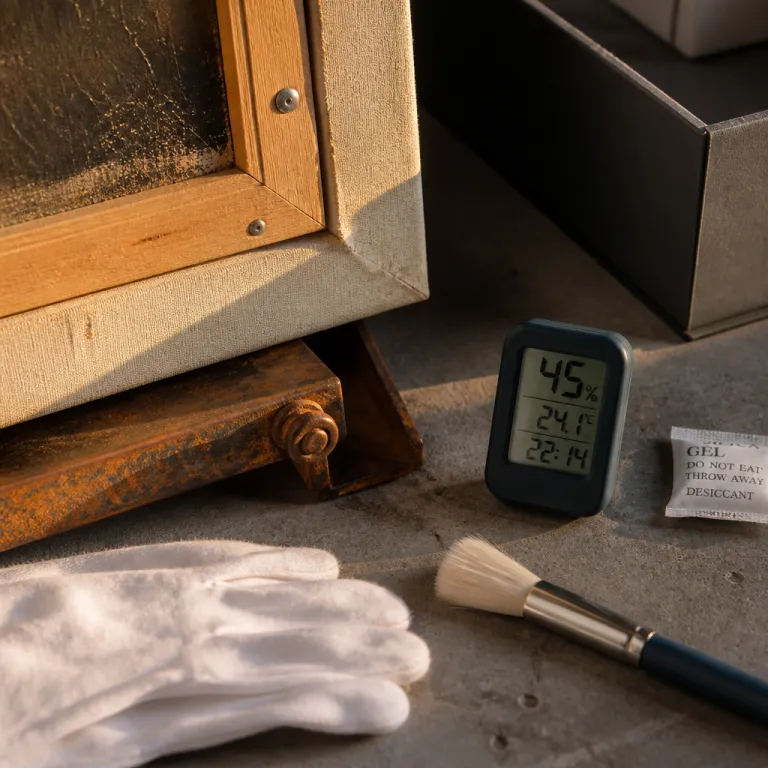
Buy a reliable digital hygrometer for every main display space, and add a simple data logger if your collection includes sensitive works on paper or fragile paint surfaces. When humidity control is poor, paper cockles, photographs curl, and panel paintings can split, so you should avoid hanging important pieces near exterior doors, radiators, or fireplaces where humidity temperature swings are brutal. Bathrooms and kitchens are almost always wrong for serious art storage or display, because steam, cooking vapour, and rapid temperature changes create ideal conditions for mould and long term damage.
For high value paintings or mixed media work, consider a small portable dehumidifier or humidifier to keep relative humidity within that 45–55 % window, especially in basements or lofts. If you must store artwork in a less than ideal environment, use sealed cabinets with silica gel to buffer humidity, and never lean framed pieces directly against cold exterior walls. For collectors planning DIY projects or new hanging schemes, pairing these climate rules with carefully chosen locations for each object will do more for proper care than any cleaning product or quick conservation treatment.
For inspiration on how climate aware display can still feel bold and seasonal, you can look at curated summer paint ideas for luxury artwork lovers and adapt the colour thinking while still respecting these environmental limits. That balance between visual impact and environmental prudence is the real mark of a mature collection. It keeps the room alive without sacrificing the quiet work of conservation.
Light and display: how to flatter without burning your paintings
Light is the most seductive enemy in any collection, because what flatters a painting today can damage it beyond conservation treatment tomorrow. An honest art conservation home guide must say that direct sunlight is never acceptable for serious works on paper, photographs, or delicate paint surfaces, no matter how beautiful the beam looks. UV radiation and high lux levels accelerate fading, yellowing, and binder breakdown, turning once vivid pieces into washed out ghosts over time.
Works on paper, including drawings, prints, and watercolours, should live at around 50 lux, while oil and acrylic paintings tolerate closer to 150–200 lux under controlled environmental conditions. That usually means LED fixtures with high colour rendering and low UV output, angled so that the beam grazes the surface without creating hot spots or glare on the frame glazing. Avoid halogen spots close to the object, because they generate heat that raises local temperature and humidity, which quietly increases the risk of damage artwork even when the rest of the room seems stable.
Use UV filtering glazing for any framed works paper, and consider roller shades or UV films on windows in rooms that hold your best pieces. If you love natural light, place the most light sensitive artwork on the shadier walls and rotate display time, treating exposure as a finite budget rather than an infinite gift. For families planning DIY art projects with children, keep the experimental pieces near brighter zones and reserve the most controlled light for the serious collection, perhaps inspired by projects like engaging kids with Northwest Native American crafts that can live in more forgiving spaces.
Handling, framing, and storage: the quiet craft of proper care
Most physical damage to a collection happens between the wall and the truck, so any credible art conservation home guide must treat handling as a core skill. Adopt a two person rule for any framed artwork over about 75 cm on its longest side, because twisting a frame while lifting is a classic way to crack glass or stress corners. Wear nitrile gloves rather than cotton when you handle smooth surfaces, since they give better grip and avoid leaving oils on metal, glass, or glossy paint.
When you move a framed object, hold it with two hands at the vertical sides, never by the top rail or hanging wire, and keep it close to your body so the weight does not torque the frame. Clear a path before you lift, and lean the work against a solid wall on padded blocks if you must pause, which prevents the lower frame edge from crushing the wall side paint or veneer. For serious fine art, consider having your framer use reversible, conservation grade hinges and acid free backboards, because proper materials are the first protective measures against long term environmental stress.
Store artwork vertically if it is framed, with spacers between pieces so frames never touch, and use flat drawers for unframed works on paper with interleaving acid free tissue. Avoid attics, garages, and damp basements for art storage, since those spaces combine poor humidity control, dust, and pests in one convenient package. If you want a deeper sense of how institutions think about storage, the guidelines from the Library of Congress on works paper and photographs are a useful benchmark, even if your home will never mimic a full conservation center.
When to intervene, when to wait, and how to think long term
The hardest discipline for a seasoned collector is knowing when not to touch a damaged surface, because restraint is often the most powerful conservation treatment. A serious art conservation home guide should make clear that amateur cleaning, overpainting, or revarnishing usually causes more damage artwork than the original problem, especially on older paintings with brittle paint layers. Surface dust on a modern frame is one thing ; flaking pigment or lifting gesso is another, and that second category belongs in a conservation studio, not on your kitchen table.
Call a conservator when you see active flaking, mould, tide lines from past water damage, or foxing spots on works on paper, because those are signs of ongoing deterioration rather than static age. The cost of a professional assessment is almost always lower than the loss in value from a failed DIY repair, particularly for blue chip pieces where condition drives auction results at Christie’s or Sotheby’s. For mid tier works, you can still apply museum logic by stabilising the environment first, then deciding whether the object needs treatment now or can safely wait for a future conservation center visit.
Think of your collection as a living archive that will outlast you, and write down basic environmental and handling rules for anyone who may inherit or manage the works. That written guide, combined with stable climate, careful light, and disciplined handling, is what keeps a private collection aligned with institutional standards rather than drifting toward slow decline. For a broader view on how institutions shape value beyond condition reports, the essay on why institutional collecting of women artists matters more than auction prices is a useful reminder that the real asset is not the certificate, but the wall it earns.
Room by room: a practical home checklist for art care
Translating conservation theory into daily habits is where most collectors either succeed quietly or fail expensively. A pragmatic art conservation home guide therefore works room by room, matching each artwork to the environment it can survive rather than the sofa it matches. Living rooms with stable temperature and controlled light are ideal for robust paintings and framed photographs, while studies and hallways often suit smaller pieces that benefit from closer viewing and lower lux levels.
Bedrooms can be good for works on paper if you keep relative humidity stable and avoid placing them on exterior walls where condensation may form behind the frame. Kitchens and bathrooms, by contrast, are hostile environments for fine art because steam, grease, and rapid humidity temperature swings create perfect conditions for mould and delamination, so reserve those spaces for decorative prints you can replace. Corridors near exterior doors often suffer from drafts and temperature fluctuations, so treat them as secondary display zones rather than prime real estate for your most valuable work.
For any room, ask three questions before hanging a piece : is there direct sunlight at any time of day, are the environmental conditions reasonably stable, and can I move this object safely if I need to adjust the space. If the answer to any of those is no, choose a different wall or invest in better protective measures such as UV films, blinds, or improved art storage furniture. Over time, these small, consistent decisions about environment, handling, and storage become the real architecture of conservation, quietly protecting what you own while the market debates which names belong on the next museum wall.
FAQ
What temperature and humidity should I aim for at home
For mixed collections of paintings and works on paper, aim for roughly 20–22 °C with 45–55 % relative humidity, and focus on stability rather than perfection. Avoid daily swings greater than about 5 °C or 10 % relative humidity, because those fluctuations stress paint layers, canvases, and frames. If you cannot reach the ideal range, prioritise keeping conditions steady and avoiding extremes.
Is any amount of direct sunlight safe for my artwork
Direct sunlight is never safe for serious works on paper, photographs, or textiles, and it is risky even for robust oil paintings. UV radiation and high light levels cause irreversible fading and embrittlement, so keep important pieces out of sun paths entirely. Use blinds, UV films, and careful placement to ensure that only indirect, controlled light reaches the surface.
When should I call a professional conservator instead of cleaning myself
Call a conservator whenever you see flaking paint, mould, water stains, lifting veneers, or foxing on paper, because those are signs of active deterioration. Light surface dust on a stable varnish or modern frame can usually be addressed with a soft brush or microfiber cloth, but anything involving the paint layer or paper surface should be left to professionals. If you are unsure, a brief assessment visit is far cheaper than repairing damage from an overconfident cleaning attempt.
How should I store artwork that I am not currently displaying
Store framed works vertically on padded racks or shelves, with spacers so frames never touch, and keep unframed works on paper flat in drawers with acid free folders and interleaving tissue. Choose a room with stable climate, away from exterior walls, plumbing, and known damp areas such as basements or garages. Label packages clearly so you can retrieve pieces without unnecessary handling or reshuffling.
Are LED lights always safe for paintings and works on paper
LED lights are generally safer than halogen or incandescent options because they emit less UV and heat, but they can still be too bright at close range. Keep light levels around 50 lux for sensitive works on paper and under about 200 lux for most paintings, and position fixtures so they do not create hot spots. Use dimmers and regular checks with a light meter if you are lighting very valuable or fragile pieces.